Tuesday, 19 August 2014

Angel or Lemon?


A distinct chill in the morning air serves notice: the season is turning towards autumn. 

It was therefore no surprise that this week’s Green-Gym session was scheduled to be our first raking-after-wildflower-meadow-cut of 2014.  This usually means site staff preceding with brush-cutter; volunteers toiling behind with traditional wooden rakes and not-so-traditional plastic tarpaulins to drag cuttings away.

What did come as a surprise (first of three this session) was that – at fairly short notice – site manager had reviewed the task schedule and … re-scheduled.  Volunteer numbers depleted by holiday and/or grandparent-duty probably had something to do with it.  So instead, we headed this morning to a different venue, task tba on arrival.

This presented the first of three hazards to be negotiated for would-be Green-Gymmers this morning: to have checked the email Inbox and seen the message about the session being relocated.  Only one volunteer found himself at the wrong car-park, wondered where everyone else was, and rang the group’s mobile number for fresh instructions.

The second hazard, for those who had not been before, was to find the way there.  An anguished text arrived on the group’s mobile from another Green-Gymmer saying, “Got lost in all the Stokes [North Stoke, South Stoke, Little Stoke]: having coffee in Wallingford!”

Surprise #2 – for those who did successfully make it there – was that the task was the same: raking.  The differences from what we might originally have been expecting: smaller area with larger number of rabbit-holes; plastic rakes; wheelbarrows instead of tarpaulins.  Also some cutting to do ourselves in a section where machinery cannot go:

"Why do trains always rush by at this point except when I'm on one?"


Essential PPE (Personal Protective Equipment) this morning: gloves.  On account of Wild Parsnip (Pastinaca sativa): hazard #3.  Wild Parsnip + sunshine + bare skin can lead to severe blistering (photophytotoxic dermatitis).  There was certainly a lot of sunshine for chemicals to react with this morning:


However, we were all very careful to have gloves on whenever handling vegetation: good as angels.  The question “Angel or Lemon?” referred to choice of cake at tea-break, not different types of Green-Gymmer.

After the break, as we moved on to different ground, there was the chance to see how some of it has changed since previous visits.  Here, for instance, is a pond, we helped to dig one winter:


Nearby, flowers as yet unidentified, but which are a species other than nettle or thistle.  This in a part of the site, where we have pulled nettles in the past, was Surprise #3:

Tuesday, 12 August 2014

Capital Work


It is remarkable how many countryside folk I know, are on record as saying they do not like fencing.  Fortunately, Green-Gymmers do.

Mention the word ‘fencing’ in the context of exercise, and naturally most people will probably think of the sport.  About which people also get passionate.

Mention it to Green-Gymmers, and our first question is: What kind of fence?  Accompanied by the thought that whatever kind of fence we are talking about, the job is going to involve digging holes in the ground.  Deep holes if gate- or strainer-posts are needed: 3’ and 2’6” respectively.

This morning, both a new gate post and a new strainer post were required.  It was easy to see why:

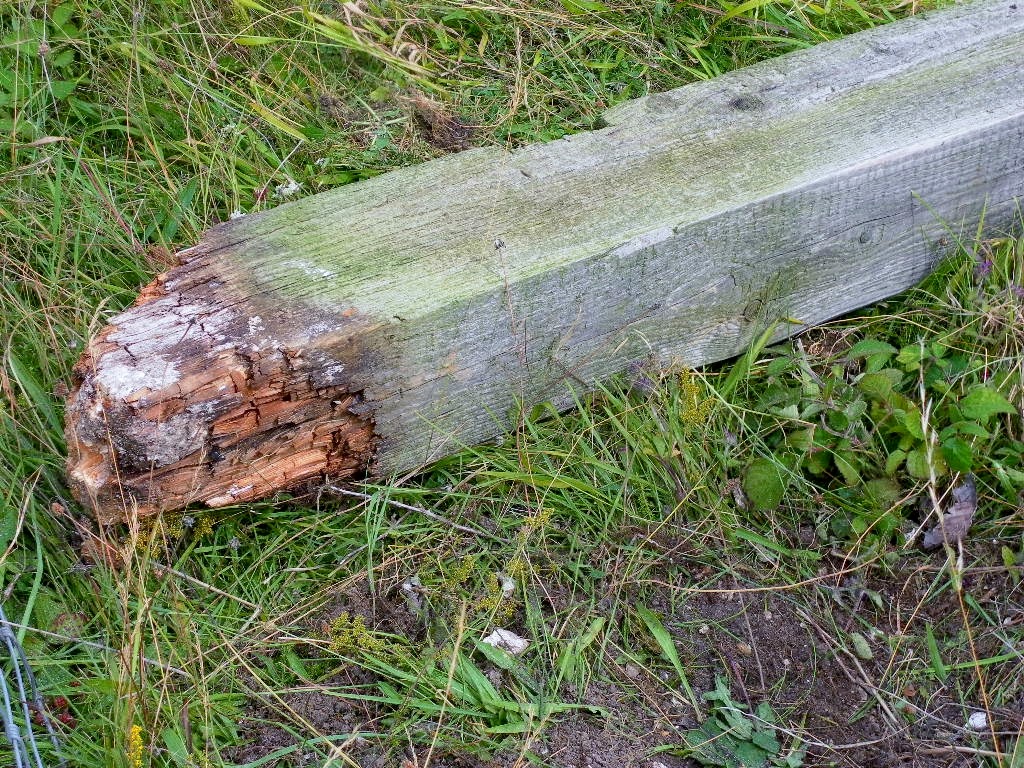
No use trying to hang a gate off that!  If anyone was in any doubt about what the problem was there, it was quite clear once the old post had been extracted:


The tasks this morning had Green-Gymmers standing, kneeling …

and even lying down on the job (not, I hasten to add, in exhaustion or despair):


The particular job in that second picture was part of the group’s second task of the day: to
remove redundant rabbit fencing.  Redundant because this particular fence-line is no longer the site perimeter, therefore no legal requirement for rabbit-proof fencing at this point. 

The positive ecological benefit from removing the rabbit-wiring is to be nice to hares and partridges.  A hare will always run uphill to escape from a predator (because its speed up the slope will usually be greater than that of its hunter), and young partridges are flightless for quite a long period after hatching.  Both species could use an extended range of escape routes, so – painstakingly, snip by snip – the old mesh was removed:


This was a new area of the site for us.  The slight drawback at tea-break was that the wind could blow away coffee granules from between spoon and mug when measuring out – and even made it hard to be sure of hot water from the thermos landing in the mug for which it was intended!  However, this being late summer, and the wind south-southwesterly, it was not an unpleasant breeze.  Indeed it was a most pleasant spot to stop and admire the view:

This was some of the landscape rolled out before us.  It gave a real top-of-the-world feeling:


Anoraksia
“Fence Capital of the World” in the late 19th-early 20th century was the small town of Adrian MI.  It was there that a Mr Page came up with the first commercially successful wire fence.  His firm sponsored the legendary Page Fence Giants baseball team, who came up with an enterprising solution for getting round the problem of segregation in hotels and restaurants.
The town, founded in 1826 by a railroad entrepreneur, was originally called ‘Logan’.  A couple of years later, his wife renamed it after the Roman Emperor Hadrian.


During the second half Green-Gymmers engaged in installing new posts insisted this was “not competitive hole-digging.”  Even so, there were some anxious glances as a tape-measure was brought out to check the depth:


That the excavation had been hard work, I did not doubt.  Especially as one of the workers was heard to comment, “It’s not so much soil and chalk, as two inches of soil on top of nothing but chalk and flint.”  If some Green-Gymmers at session end stopped to admire their handiwork, this was entirely understandable:
“It looks like Canary Wharf
There was some speculation that this Green-Gym monument would be visible from the M40.  (Next time one of us is driving east along there, we must try to remember to glance up!)  I suppose it was the smudge of chalk on hillside which also led to speculation about what archaeologists in the future will make of “the early-21st-century neolithic revival”:


For now it is probably over to another volunteer-group to hang the gate.  Our next trip to this site is not until mid-September, by which time it will probably be scrub-bashing season again.

Tuesday, 5 August 2014

Larking about


It’s not often, as a grown-up, that one gets to have fun messing about in a gentle shallow stream. 

That, however, was essentially what Green Gym had to offer this morning:

The excuse for mucking about in the water having fun was watercress.  Growing conditions at that spot are ideal, so – unless one is happy to have the stream constantly shifting course – excess watercress has to be removed.  By hand, if you’re Green Gym. 

“It’s like pulling out the entrails of something,” remarked one new-comer.  As this was said with a broad smile, I think she was happy enough – just surprised at how very long watercress can grow when the going is good. 

Vegetation overgrowing from the river bank had also to be cut back, and hurled to one side:


Those working downstream were tasked with scooping up the little bits of loose vegetation which escaped.  Note the old wire basket strategically placed on the bed of the stream as a makeshift sieve: ‘handy as a pocket in a shirt’, as they say in Wisconsin:


At break-time the volunteers on tea-crate duty performed a small marvel with flasks of hot water, which somehow never ran out.  This prompted thoughts of the ‘widow’s cruse’, though why it should be called that, I do not know, since the miracle can be chalked up as one to the prophet Elijah (1 Kings 17:7-16) and emulated by his successor, Elisha (2 Kings 4:1-7).

An unexpectedly generous supply of hot water was called for on account of our numbers at the session having doubled overnight.  When I had turned off the computer the previous evening (earlier than usual, on account of the Lights Out commemoration), our forecast numbers were half a dozen.  On checking the email inbox in the morning, I found I should be expecting 11.  In the end there were 12 of us plus site warden!  All were most welcome, and with so many pairs of hands at work, an entire stretch of stream was cleared, which was very satisfying to see.

As we worked, the passage of time was marked not by sounds of nature, but by a helicopter from nearby RAF Benson making repeated circuits with an underslung load:


The height at which these manoeuvres were practised may be estimated from its clearance above the medium-sized trees on site:


I strongly suspect that the first or even second time round, this is exciting for a pilot.  By the sixth time, tiredness and routine may be beginning to set in?  I guess learning how to continue to handle the aircraft safely precisely when feeling tired is part of the curriculum for aircrew.

Meanwhile, Green-Gymmers could pack up and head off home, perhaps already eagerly anticipating whatever next week has in store for us.