A game of
musical cars was how our morning began: fitting in a slightly larger number of
vehicles than we had been expecting into a remarkably small space.
Having resolved
the problems of the temporary car-park (and noted that C was the only driver
who needed to be ‘marshalled in’ to get through the only-just-wide-enough
entrance: well done, everyone else), most of the group proceeded to a game of
musical barrows. This was all in aid of
moving rotting logs from one area (fen), which is a good habitat in its own
right, to a place where they could be good beetle-habitat.
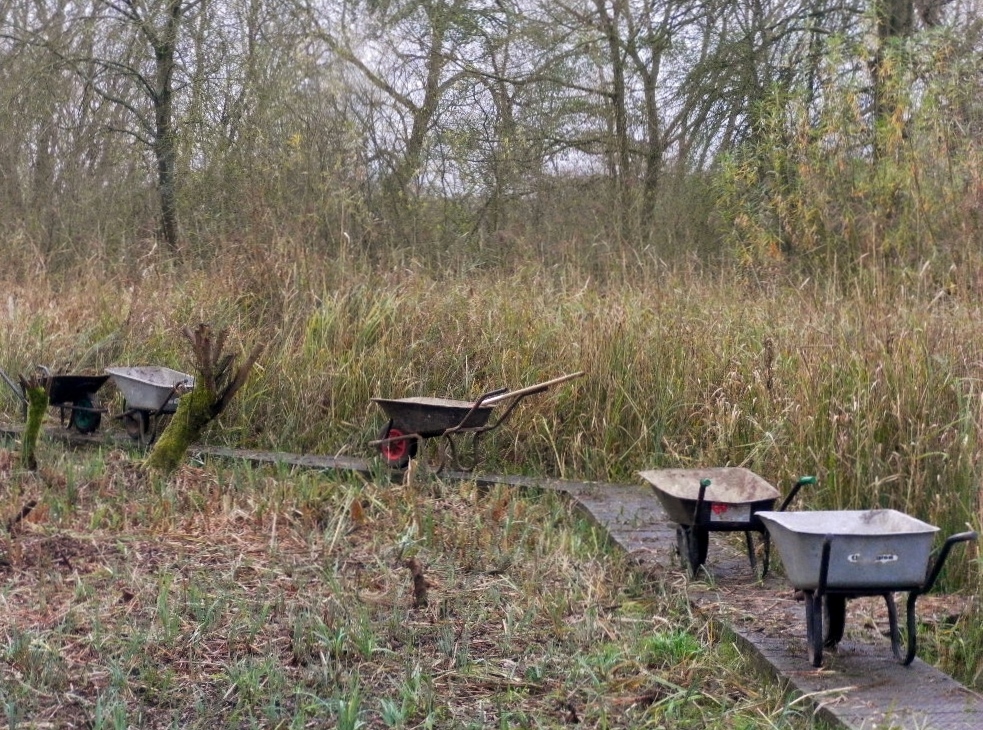
Here the
barrows are lined up ready for action – except that one is facing the other way:
Which way
was the right direction, was something which was not entirely clear. The problem was that, by the most direct
route, the distance was only a short one, but cumbersome. A bridge-widening scheme would be welcome:

That to
avoid loading, unloading, and reloading, the barrows would need to be
wheeled in the opposite direction, was not something which many of the volunteers
heeded until after the first batch of wood had been loaded:

At that
point, a practical time-and-motion experiment was launched. Some Green-Gymmers moved towards the narrow
bridge. While others turned their
barrows round, and set off on the long walk around the boardwalk:


It was a
slightly eerie landscape to be working in.
The cold light of a grey late-November day did not greatly enhance the charm of our
surroundings:


Volunteers
were nevertheless heard to comment that it was their “favourite job”,
manhandling bits of wood, so they seemed happy enough. And the result of the transport experiment
was that those who took the shortcut via the bridge arrived first.
Meanwhile,
down by the river, a pair of Green-Gymmers was also happily engaged.
They were happy because they were doing a job which was quite unusual for us – something literally constructive for a change:
They were happy because they were doing a job which was quite unusual for us – something literally constructive for a change:

That is the
latest in innovative housing in rural Southern Oxfordshire, lovingly designed and handcrafted,
to meet the requirements of highly discerning customers: Sandmartins.
The task for
our volunteers was to put in an extra layer of intruder-proofing:
what they described as ‘skirts’. As one
of the site staff cheerfully explained, the idea was to avoid this development
becoming “the McDonalds for rats”. Extra
timber panels were cut to size, then glued and screwed in place, with an 2”
drop all round:


My own place
in all this was principally as bringer of additional wheelbarrows, extra tools,
etc to order, beginning with a hammer.
As the volunteers explained:
You’re gopher-in-chief today really.– Yeah, go for it, Chief!
Duly going for it (in the sense of cheerfully walking over to the tool-shed), I wondered what kind of hammer was required. Not a silver hammer, obviously; or a toffee hammer.
“An ordinary carpentry hammer,” they had said; but the only one I could
find was more of a lump hammer. I
decided to take it along anyway, and then undertake a further search for a
regular hammer. As it happened, to knock
in timbers into their respective slots, a lump hammer was precisely what they
required.
Tea-break
was enlivened by an extremely chocolaty chocolate-cake for a volunteer’s
birthday, discussion of a date for our ‘Christmas’ social (as in previous
years, a Tuesday late in January), and the showing off of our latest piece of
kit. Most groups would have a fire-box
(containing matches, kindling, etc) that is red. Ours is green – a model chosen for its
waterproof properties:

After the break, the housing team continued
with their improvements to the new Sandmartin block. Some of us stayed beside what would have been
the fireside, had we had a bonfire today, to help with moving items connected
with the restoration of the winch. The
winch itself needed to be lowered to a horizontal position, and secured. Other items, awaiting assembly, were sorted
into storage spaces. These two bearing-caps
had been through the restoration process:

The one on the left has just been
cleaned. The one on the right has been
cleaned and re-painted. Eventually – in about
two years’ time – the whole winch mechanism will be gleaming in fresh black
paint, and the bearing-caps will be in their proper position:

The rest of the volunteers moved straight on
to clearing cut reeds. These had been ‘shaved’
off by heavy machinery in the area overhung by the willows, which had presented
such a hazard the previous week. The
reeds had to be raked, pitch-forked into barrows, and wheeled to the bonfire
site.
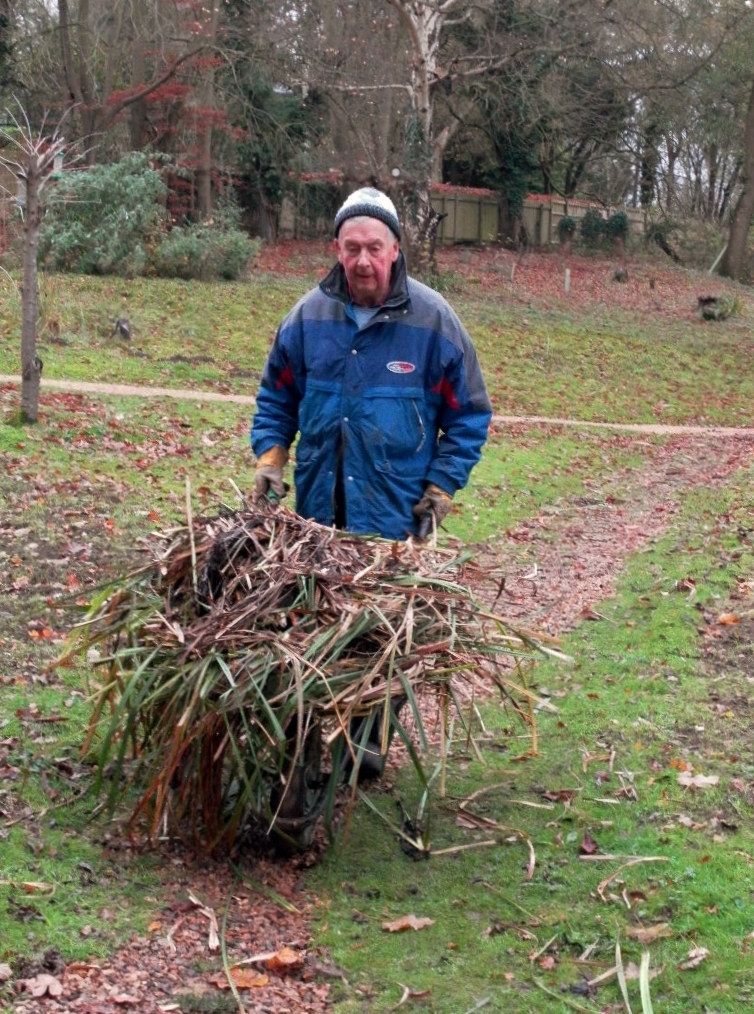
Transporting the cut stuff was not so easy
with barrows almost overflowing. The
wheelbarrow-wheelers concentrated ever so hard:
But no matter how hard they tried (and it was
very trying: I know, I had several turns myself), even so they would often have
to stop to re-position the load …

and they left a trail of reeds along the
footpath:

We must be sure, the present site staff said,
to return to the spot in April. For
where we had been working, should by then be a carpet of white. – Witness the
first small shoots of the famous Thames-side Loddon Lilies: