Showing posts with label fence-line clearance. Show all posts

Tuesday, 15 May 2018

Cake and Cocktails


By ‘C’:

“We all have our melting point!” declared one volunteer.

Fortunately, no melting point – of either volunteers or victuals – was reached today.  For the north wind doth blow, and in May here that typically means blue skies horizon-to-horizon, without it getting too hot.

Today was no exception.  It was a lovely day to be out in the countryside: blue sky, fresh-faced leaves, cow parsley on the verges now bordering on 4' tall …


Perfect Green-Gym weather in fact, ordered specially ;) along with the cake, to mark a member’s birthday:
“Not quite sure what state the emoji is meant to represent!
And the ‘cocktails’?  Mocktail jellies: piƱa colada, cuba libre, and watermelon daiquiri flavour!

Today’s location: an undulating section of the Chilterns scarp.  Task: fencing.  With plier, hammer, and spade, of course, oh and one or two other tools, rather than mask and foil. 

Many of us recognized at once the particular spot, as one we had worked on before.  Some knew one side of the corner to be the end of a long perimeter-fence-line, the upper section of which we had cleared of encroaching vegetation before starting on the business of replacing old timber-posts and wire with shiny new metal posts + fresh wire:

Others knew the short length, set at 90° to the main fence-line, to be one where in the past we had carried out ‘first-aid’ work, replacing some of the posts to give the fencing a few years’ extra life:
So part of our work today was to undo work which we – or previous WGG-teams – had laboured on!  [I think this is the first time this has happened – Ed.]

This morning, one group concentrated on putting in the new posts to complete the line for the perimeter fence.  The larger force made a start on the field-end fence-line.  Rather a lot of vegetation clearance was required first:

Inevitably this meant that some ambulant creatures had to find a new habitat for the timebeing:
Why did this creature not just fly away?
Interesting specimens of plant-life, which naturally cannot relocate, we were careful to work round, eg orchids and wild strawberries:


Some of the posts we could readily identify as WGG-handiwork: newer timber; sunk in solidly; and wire attached by staples which had been left proud.  Where the work had been done by our Green-Gym forebears, this made life much easier for those engaged on the intricate task of removing staples:

It made life much more difficult, though, for those tasked with lifting a post out again:


At half-time, we demonstrated how to recycle fence-posts.  Those already extracted, made an excellent low work-top for the tea-crate volunteer:

By session end we could see that we had surprised ourselves with the amount of progress which had been made on both fronts. 

The perimeter fence was particularly pleasing.  It will look even better when it is finished, including a garnish of a single strand of barbed wire along the top:

The other section had been prepared as far as the eye could see, for the next work-party to continue with putting in fancy new posts in all the places marked:

Tuesday, 24 April 2018

A cunning plan or a slightly cuckoo idea?


By the Session Leader:

Today we were to be working at one of our favourite sites: the Queen’s Arbour – the southern section of Lower Meadow, below Wallingford Castle.

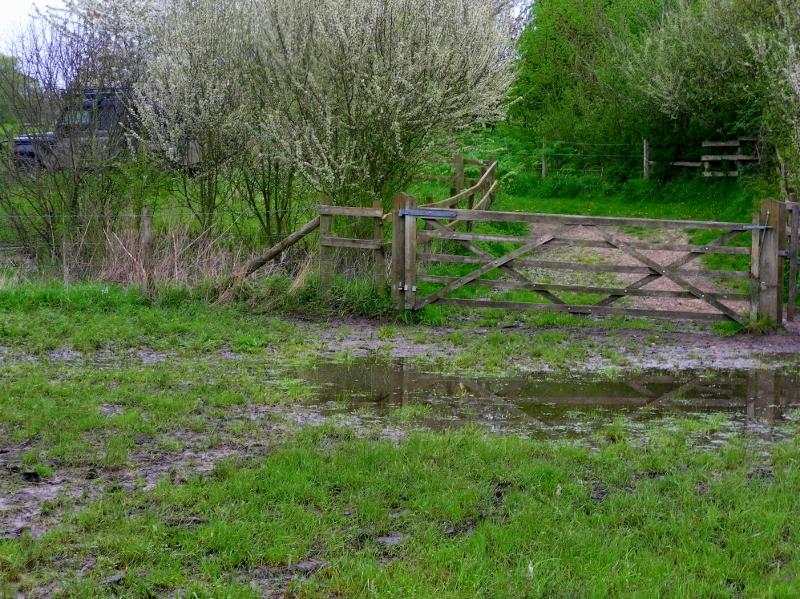
The gateway to Lower Meadow was flooded:

Those of the team who had parked in the lane, to meet up at our usual RV point in the Upper Meadow (that was most of us this morning) had to walk the long way round:
But that was not a problem.  The site warden led the way, and pointed out some of the flourishing botanical life of the meadows.  This, for instance, Cardamine pratensis, is better known as the Cuckoo Flower or Lady’s Smock:
[We hoped its delicate beauty was not a presentiment of nature mocking our endeavours in the royal lady’s arbour. – Ed.]

Our main job was to dismantle an old fence-line beside the Thames Path, ahead of contractors coming in to put in a new one.  New fencing, that is, not a new public footpath.

The first task was to prise out staples from fence-posts, before the barbed wire could be retrieved.  This was where heavy-duty fencing pliers came in handy: lighter examples of the tool proved to be not fit for purpose.

“Four lines of wire,” said the site warden.  One line of Green-Gymmers promptly stepped forward – each volunteer working on one post at a time:

Some of us considered that the hardest part was simply finding four staples per post:

Others maintained that locating the metalwork was the easy bit: the difficulty came when trying to extract staples where they had been driven right into a post, flush with the timber, rather than being left slightly proud so that a worker with pliers could get a hold and lever them out:

Once the staples had been found and removed, the barbed wire could be rolled up into neat coils.  This was one volunteer’s technique.  It may look like he is practising his moves for a spot of May-morning Morris dancing:


Actually he is not just waving the stick in the air, he is rolling the wire around an improvised spool to save handling the barbs:

This left bare posts to be removed: a task which had defeated us in the past – and which we could have left to contractors with their tractor.  The difficulty in the Lower Meadows is that the ground is frequently sodden, meaning wood which has been sunk into the earth, swells.  When a Green-Gymmer comes along and tries to lift out a fence-post, it either snaps at ground level, or sits tight and refuses to budge. 

But Green-Gymmers always look forward to a challenge!  We had therefore put on our thinking caps during the week, and begged the site warden if she would very kindly “please postpone the tractor till we have had fun trying?”

Our plan was this.  In order to achieve sufficient purchase on a post to lift it by hand, we would drill a hole, about an inch in diameter, through the post, pass a yard-long steel rod through the aperture, and twist the post to free it up:

And with a person either side, twist a bit more …
then heave …

and heave again:

The relief when this method did sort of work!

Modified rapture, however, was all we could muster.  Moderate success had indeed been achieved, but it took much too long to lift more than a few posts.  More work is needed to improve the technique for next time.

Meanwhile, for those who had finished with removing metalwork (or vegetation) from the fence-line, there was another job: to dismantle and remove an old burn-platform from the other side of the meadow.  Those who opted for that were given tantalising glimpses of bluebells in the pond area beyond the ditch:


At session-end, here was proof positive that the ingenuity and labours on the part of the fence-removers had achieved at least some success: