By ‘C’:
‘Why couldn’t it have been Green Gym
yesterday?’ is a common enough lament from a session photographer.
Somehow the light is always better the day
before, or will be tomorrow.
Yesterday, a lingering mist may have disappointed some bank-holiday-weekenders. For shutterbugs, however, the unusual
light-conditions leant an eerie beauty to the Chilterns landscape:
(Dampness also meaning one could be walk all morning and meet with any number of rabbits and skylarks – both species
supposedly in decline in Britain: evidently not in rural South Oxfordshire – but
as for humans … Well I saw just three cyclists, two hikers, and one dog-walker;
oh, and a wingwalker.)
The mist did, eventually, clear. After warm sunshine in the afternoon, topped
by a glorious sunset, it seemed reasonable to hope that conditions would be
good today as well. But no! Good for doing Green Gym; not brilliant for
recording it for posterity …
The site warden had told us he had “a
range of interesting, challenging tasks which members of your team would not
want to miss.” If there was an element
of gently irony in that statement, there was nevertheless a spread of tasks for
volunteers to choose from, as we gathered on the banks of a characteristic Chilterns
chalk stream.
If it had
been a bright summer’s day, it would have been an idyllic scene. You can let your imagination play with these
images?
Even on a
grey day, it was really rather a lovely place to be. Especially as we were lucky enough today to
have an acoustic backdrop of gentle birdsong, but almost nothing else bar the
sound of the wind in the wild grasses, and the patter of the odd cute bunny scampering
out of the way. And it could have been quite
challenging: witness, the surprise amber rain warning posted by the Met Office
this morning. Fortunately, Green-Gym fell
into the category of the 30% of occasions when the prevailing conditions did
not result in a downpour.
One option
for volunteers today was to do some raking: to remove cut material from “patches”
in the wildflower meadow, and transport it to the compost area. The patches had been generated by an exercise
to try to knock back the Meadowsweet (Filipendula ulmaria). As
the name suggests, it is a sweet-smelling flower; and does very well by the
neat trick of producing a heady fragrance (which for many people is the
scent of summer in the wild), but no nectar: the insects keep visiting it regardless. Unfortunately, at this location it has been doing
rather too well, and threatening to monopolise the meadow.
Two
Green-Gymmers promptly peeled off to set about raking. Then returned about 30 seconds later, remarking
a little sheepishly, “We might need rakes.”
A sentiment with which their colleagues readily agreed!
Once fully
equipped, the rakers did rather a good job:
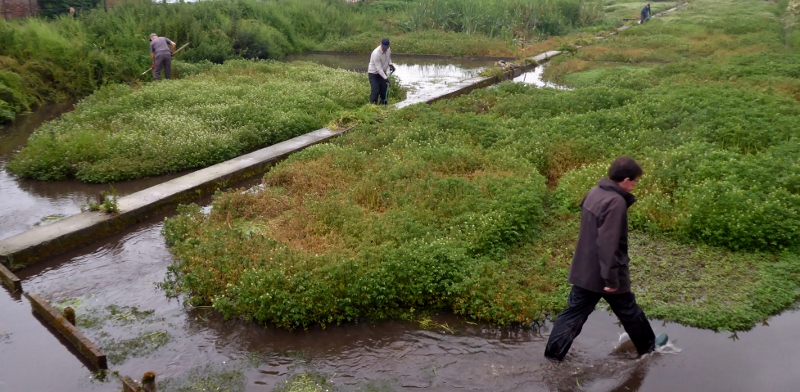
Task 2,
which absorbed most of the manpower available, was to weed a section of the
stream which is supposed to be devoted to watercress:
Looking at
that photograph, you may wonder what the curious object is, which can be made
out in the background (top edge, in the middle). It is in fact what I would call a ‘bug hotel’. Only this one is more superior, and is billed
as an ‘Insect Palace’:
The weeding
is still done by hand, as it was in the days when this was a working
watercress-bed:
The weeds are
then moved – like the cut materials from the wildflower meadow – by muscle-power
and wheelbarrow to compost heap:
And the
definition of ‘weed’ in this context? It
was not as simple as ‘any plant which is not watercress’. For the beds being worked on are substantially
colonised by Crowfoot (Ranunculus
aquatilis), aka White Water-Buttercup.
Which would normally be quite desirable in a stretch of Chilterns chalk-stream,
just not in a zone right outside a Watercress Beds Visitor Centre! OTOH, it is difficult to eradicate, and Green-Gymmers’
time and effort were better directed towards other species.
Which species,
precisely, was a question which came up throughout the morning. This specimen, for example, which one
Green-Gymmer carried round the site looking for someone to identify it, and
decide its fate:
It was with
a friendly smile (or it would have been impossibly rude) that, inevitably, at
least one Green-Gym colleague called out, “Are you sure that’s not too heavy a
load for you?”
Not that I
personally was of much more assistance.
All I could say was that it was a water-plant, but not watercress. For if some of my fellow Green-Gymmers will
cheerfully admit to being “botanically challenged”, they have nothing on me, who
sometimes has difficulty telling animal from vegetable from mineral. Yesterday, for example, I had no idea that this
slimy blob on top of a poppy flower was not some creature which was going to bite
or sting me if I examined any closer:
It was,
almost certainly, just the outer covering of the flower which, in poppies, (usually)
falls away as the flower opens. Which just
goes to show that this Green-Gymmer can be about as smart as a stick. [Well
you said it – Ed.]
As for the
mystery plant in the stream, that was assigned to the category ‘weed’: “probably
Mimulus [guttatus] – Monkeyflower. It’s a garden escape. Pretty, but a real pain.” According to the NNSS (Non-Native Species Secretariat,
a Defra agency), it is “very stoloniferous and so tends to form extensive
stands in suitable conditions.” In its
native western USA, Canada, and Alaska, it is in the wild limited to eking out a
living in marshy areas and high-altitude meadows. In Europe, it grows rampantly beside river,
rill, or stream, alongside ditches, on wet pastureland, in disturbed ground,
etc.
Meanwhile, as
the morning advanced, the third team was progressively reinforced until it
became a regular chain-gang. The gang
was engaged on what had been billed as the mystery task of the day. “Path levelling” the site warden had said: “major
earth moving job – not for the fainthearted.”
He was not
kidding. I had not supposed that he
meant this kind of ‘not for the fainthearted’:
And we know
I can be as bright as Alaska in December.
Even so, I do not think I was the only one at Green Gym who had not envisaged
the immensity of the operation.
It
really was to remove an entire embankment – just like
building a railway.
Unfortunately,
impossible to convey the sense of scale by photographic image!
First item,
vegetation removal:
(On the left, behind the brash heap,
you may be able to make out one of the rakers on the wildflower meadow.)
Then earth-shifting:
Followed by …
a break. Being a navvy made even the
strongest Green-Gymmers need to pause and take a breather, while being briefed
on the bigger picture of the project:
The line of
the new path was surveyed:
Then back to
the hard toil:
– For those
who were still stout-hearted, that is. As
for me, I don’t mind admitting that half a dozen spells on that were as much as
I could manage.
It was at
that point I swapped mattock & shovel for camera again. There was, after all, some vital photo-reportage
to bring to a conclusion: to show how much was achieved over the course of the morning. Results from raking are more easily seen by
the naked eye than through the lens of a camera – sorry! The effectiveness of navvying and weeding,
though, yes that I could document:
 |
| Before |
 |
| After |
 |
| Before |
 |
| After |