Tuesday, 3 March 2015

And another thing ...


You know you’re getting old when you discover you can’t use The Pitchforker’s Pride is a Fallacy for a blog title, because you’ve already done that once.

And if you think you have already read a blog once about clearing scrub on Linkey Down, that’s because you have.  Today was session #2: same task, same tools, same barbed-wire fence in our way:


Today was a good day to be out on the Chilterns scarp:

(Impossible to tell from the photograph that what had attracted our attention was a herd of fallow deer, on the far slope.) 

It felt cold, though, on account of the wind.  Note the insulated pitchfork:

Most of us kept layers of winter-warmers on throughout the session.  Some endeavoured, with varying degrees of success, to use the power of the wind to assist in lobbing cuttings over the fence. 

At tea-break, when the weather threatened briefly to turn nasty on us, some volunteers were glad of the shelter newly created by all the brash thrown (whether or not wind-assisted) over the fence-line:

As always – or so it seems – when we go to that site, the direction in which cuttings had to be transported on the slope was: UP.  This makes for an excellent cardio-vascular workout; also strengthening of glutes, quads, and hamstrings – and a good appetite, come tea-break!

In the second half of the session, as volunteers started to weary, a casual observer might be forgiven for thinking that we a. had a man down, b. didn’t care!

It was only on approaching closer that one could see that this was not a case of “him and work had a fallin’ out” (as they say in Wisconsin).  Also that the Green-Gymmer was very much still alive, but the stubborn treelet in his way would soon be food for the fire:


As for the creatures for whose benefit (as well as our own health) we were doing all this work, they made a brief appearance at the start of the session.  This was largely for the purpose of checking out that none of the site warden’s kit included extra rations for them:


Double-checking that there were no mineral supplements in any of the boxes was a process which had to be repeated several times.  Of all our customers, sheep are the most woolly-headed, literally and metaphorically: it is only in the movies that sheep are the quick-witted, resourceful heroes.

However, at least when we are doing things for sheep, no Green-Gymmer pipes up with “What are they good for?”  For everyone knows that sheep make for mutton pie and rogan josh – as well as providing wool, which can be turned into winter-warmers or works of art / cultural-political statements:

Tuesday, 24 February 2015

“Sunshine, coffee, cake …”


“… what more could one ask for?” remarked one volunteer.

Answer: windspeed a little lower in this exposed part of South Oxfordshire, the cynical might think.  Nevertheless, it was indeed a very good morning for getting together with friends in the great outdoors:


The work – our bit to help transform plain field into butterfly-friendly meadow – would have been easier if the soil had been a tad less heavy.  However, we would far rather the soil be “a bit sticky” (as Green-Gymmers described it, with just a dash of understatement) and the sun be shining on our backs than if the earth had been nice & friable from a period of dry weather, while the rain was pouring down the back of the neck.

Tasks did not consist entirely of digging, though there was plenty of that:
 
There was also the planting of a tree ... 

the transplanting of plugs of wild flowers ... 

the cutting back of a hedge-line ... 

and jobs where it was not entirely clear to the onlooker what Green-Gymmers were doing, but the side warden said they were doing it very well:


There were also some distractions, eg the neighbouring farm, and the frequent trains:


Plus, of course, cake at tea-break.  Including lemon-drizzle.  – Just bad luck on those of us for whom today was the first Green-Gym day of Lent 2015!

Tuesday, 17 February 2015

Extreme Gardening


Today was one of those occasions when volunteers had to be kept well away from the neighbours.

This was one of the neighbours’ houses:


Green-Gymmers had to be set a task well away from them not because our activities would have disturbed them, but because they would have been constantly distracting us.  This on the way to our work-site:

And these were next door’s children, having a wonderful time in the great outdoors, getting thoroughly messy from head to hoof:

Pigs in their natural habitat – woodland – are a rare sight nowadays.  These ones were very happy pigs.

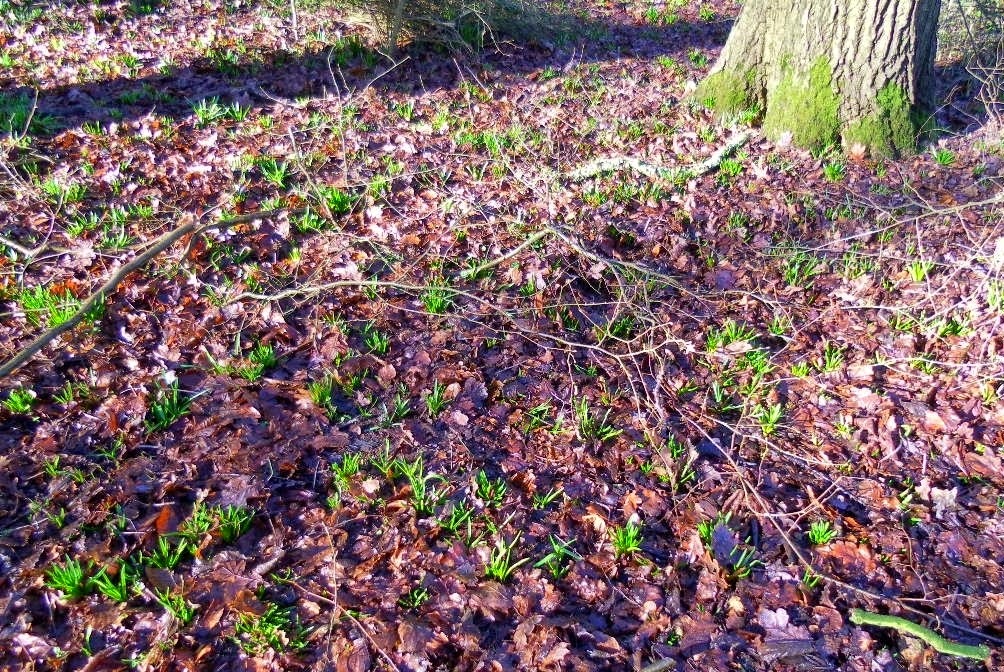
Our task was to help bring back old woodland to coppicing rotation.  In the early 20th century the area probably had been managed for coppicing (hazels and some standards).  That the woodland is old, is shown by the presence of bluebells – yes, proper English bluebells:

Come March/April, this woodland floor will be a haze of blue:


In the meantime, there were old trees to be cut back.  Here is one which had been done earlier:

Note the brash piled round the base (to obviate depredation by deer), and some leading shoots left so that the tree can regenerate (even if some hungry deer do get through the defences).  During the extensive briefing we were told, “There are more deer in the UK now than ever in history.”

Cut wood was recycled, according to size/straightness, as:

  • Stakes and binders for use in hedge-laying
  • Logs for firewood
  • Brash to put round the stumps
  • Material for brash piles neatly constructed so as not to intrude on bluebell habitat

This involved much use of time-honoured tools and methods.  Here a happy Green-Gymmer deploying a billhook:


There was much instruction given on the angle at which to wield one’s billhook.  “A 33⁰ angle” definitely came into it somewhere …

There were also some interesting alternative uses of tools.  This, for example, is not a billhook carelessly left on a stump.  It is for cutting lengths of string:

And this is not a hurdle for a hedgehog gymkhana …

nor a hoop for an extreme version of croquet.  It is for holding a bundle of sticks off the woodland floor, while the length of string is tied round:


The soundscape included, to our delight, the extraordinary sound of happy pigs sleeping it off (who knew pigs could snore so loudly?) and a woodpecker drumming, on a tree, as it should.  Apparently the way to identify the species of woodpecker is to remember that a Great Spotted Woodpecker produces a short ‘drum-roll’, and the Lesser Spotted a long one; while the Green Woodpecker is the one which laughs at you. 

“Yes, there’s one at the golf course which does that,” volunteered one Green-Gymmer: “It laughs even before you’ve putted.”
– “You’re not supposed to putt with a woodpecker,” came the rejoinder: “You’re supposed to use a club.”

(Shades of Lewis Carroll there – Alice trying to use a flamingo as a croquet mallet?)

Green-Gym itself perhaps bears the same sort of relationship to normal horticulture.  
For it has been described as “a combination of extreme gardening and walking, plus just being out in the great outdoors” – in the right kit, of course.  Except that at Green Gym the range of ‘right kit’ varies from the old-&-battered-and-it-doesn’t-matter-if-it-gets-torn-and-muddy to the real town & country look:

All are equally welcome at Green Gym!