Tuesday, 16 February 2016

Fun in the early-spring sun?


By C:

One way of consoling oneself for not being able to get to a Green-Gym session is to think that it didn’t look as if it was going to be particularly good that week.

Unfortunately (for me: but fortunately for those able to attend), today’s session looked like it could be a lot of fun in the late-winter sunshine, as well as good exercise.  This from the session leader’s invitation:

  • Plenty of work and plenty of ‘lopping and sawing’.   (Site warden didn’t mention a fire.)
  • Plenty of water so wellies will be needed.  Thames is well over the banks here.
  • Forecast is cold for next week so plenty of clothes too.


That the level of the river in Wallingford was high the day the notice for Green-Gym landed in my Inbox, I can vouch for:
River Thames seen from Wallingford Bridge: looking upstream

View downstream


How green will I feel when I hear the session turned out to be every bit as fantabulous as anticipated?  (Though it probably won’t have been as exciting as tree removal the industrial way.)


From the session leader:

A bright frosty start …
to what turned out to be a lovely day. 

Our engineer Green-Gymmmer started by revealing a new heavy cart for the nature reserve.  He had made it entirely from recycled parts, showing that WGG has more than just countryside skills:

And he then put it to the test:


The main task for today was clearing fallen trees from neighbouring land …

and carrying the mountain of brash back to the fire site …

by various methods …

to where the fire-raisers had been busy:


Another team was busy erecting fence posts ready for a willow screen to give the sand martins and their families some privacy.   Note the essential hard hats:


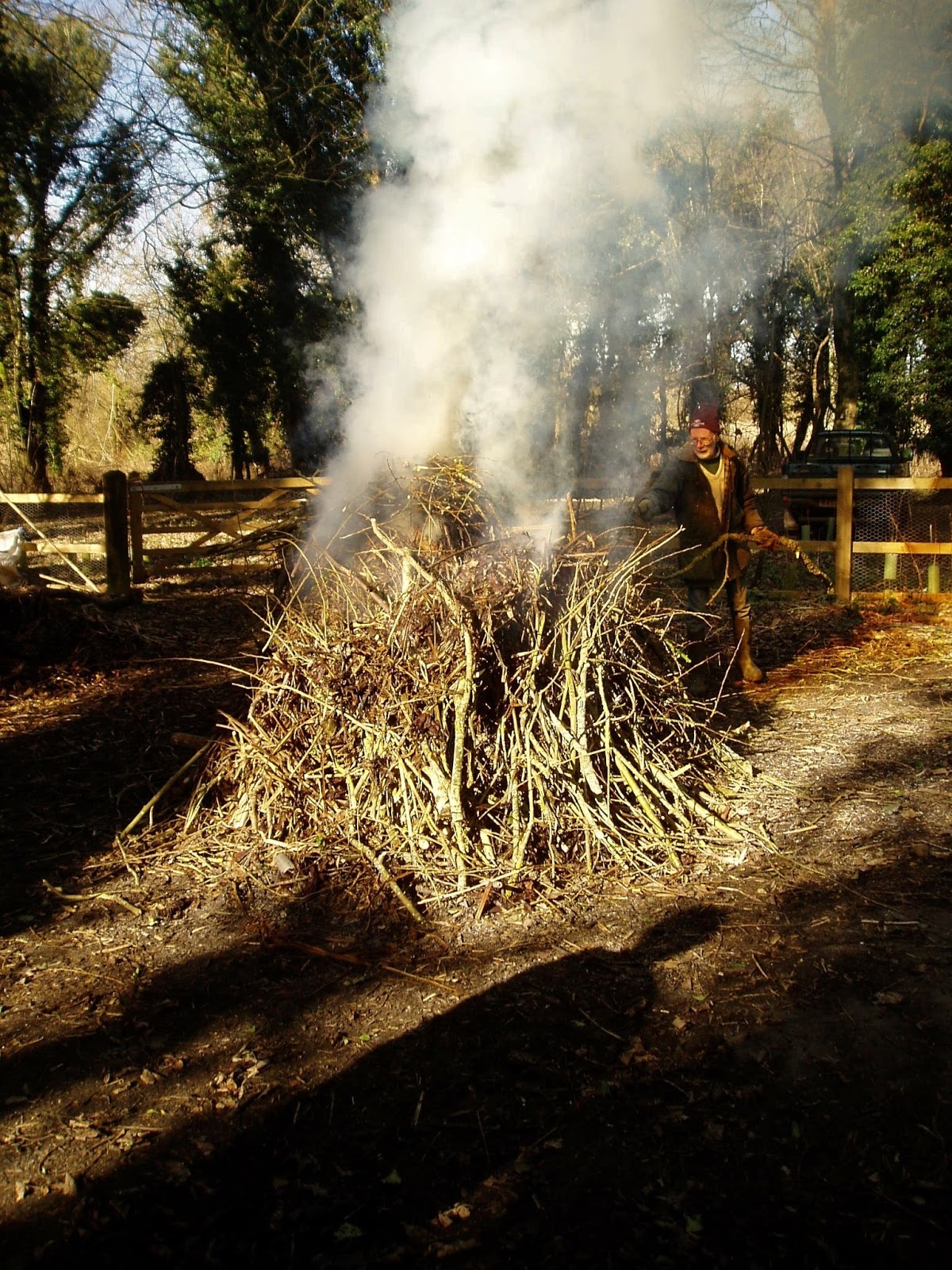
By the end a good fire was going:

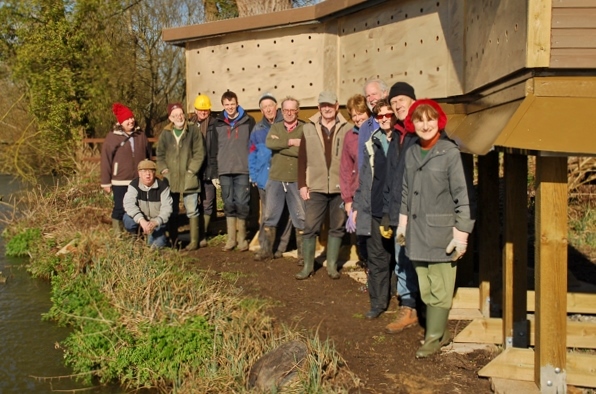
For the nature-reserve records, site staff took a photo of the whole group against the sand martins’ home, which many of us had helped to build:


Tuesday, 9 February 2016

Friendsheep


Our arrival on site this morning caused quite a stir among some of the residents:


Unfortunately for the livestock, our turning up did not mean love and attention (or extra food) being given to them.  Instead we were back to the task of doing nice things for pollinators.  Apparently, if you want to be nice to the nation’s butterflies, bees, etc, then the best thing you can do is to preserve – and, where appropriate, extend – calcareous grassland.  For what insect pollinators thrive on, is a steady source of different kinds of pollen across the summer season.

Habitat management in this situation is all about getting the balance right.  A small amount of habitat suitable for nesting birds is good.  Too high a proportion, and chalk-grassland flowers do not get enough of a look-in.  Which means that Green-Gymmers get to do something we enjoy, and is good for us by way of exercise and teamwork: clearing excess scrub and bramble.


Cutting back the brambles, so that they do not instantly re-grow, means cutting back as low as possible.  Getting down on hands and knees gave me this view, when I looked up:

At that stage in the morning, the weather was not entirely sure that it was done with winter-storm Imogen.

More of a hazard, in the sense of having to watch where we were going, was presented by the engineering works undertaken by generations of ants and rabbits:


As the old proverb says, there are creatures on earth which are small, but punch above their weight.  OK, maybe that is not quite what the Hebrew says, but you get the drift:

the ants, a species not strong, yet they store up their food in the summer;
the coneys, a species with little power, yet they make their home in the rocks
(Proverbs 30:25-26)


Individual Green-Gymmers vary greatly in strength and experience.  Working together, however, we are a force to be reckoned with.  Though to be sure, the notable examples of Green-Gym teamwork I saw this morning were perhaps not what would be quoted in a handbook for how to make your community group brilliant:

  • One Green-Gymmer looks at a small tree, to select it as a target
    Green-Gymmer next to him, pulls it out with her bare hands, roots and all
    (They cheerfully explained that the fall of another tree before, had done most of the demolition work for them!)
  • At tea-break, one Green-Gymmer buttered the pancakes (yes, today is Shrove Tuesday), another volunteer spread the jam, and a third distributed.


Cut wood which could be put to good use, was salvaged:


Brash was fed to the flames for instant recycling of the compounds in it:


At session end, there was a heap of tools to be taken back, and a long walk (downhill) back to our transport:


Looking back, we reflected that, over the years, we have done a fair bit of work in that particular corner of a field, beginning by taking down redundant fencing.  When you look at our before and after photographs for today, you can just make out the remains of old strainer post and support:

At the start of play today
After: that’s better (“Can’t stand fences”)

Wednesday, 3 February 2016

Log-arithmic work


By the session leader:

Here’s a squiggly tree.

Today’s task was two-fold.  First, planting a range of small trees: hawthorn, hazel, a viburnham (I forget which sort), rose, and I’m sure a couple of others.  These are to provide an understory, to support a range of small wildlife in an area where there are only large trees, like the one above.

In this picture of our briefing, you can see the funky spades we used: Schlich tree-planting spades.  They are named after Wilhelm Philipp Daniel Schlich, the eminent German-born forester, aka Sir William Shlich of the 19th-century Imperial Forestry Service. 
 
Step 1: dig a slot, and lever the ground up on either side, to make plenty of space at the bottom.

Then plant your tree, heel it in firmly, add a stake, and wrap the protector round it, making sure the bottom is well covered away from the gnawing teeth of small mammals:

Hey presto, before tea-break, the new understory with 70 new treelets ready to grow:

The forest floor was, as one volunteer put it, “like walking on moss.”  I wonder if this fungus is edible – there was loads of it on a dead silver birch:


After tea, our second task was to move last week’s logs up towards the track so the site warden could collect them later in the truck.  The human train got a good “logorhythm” going, which decimated the work:
That’s the power of logarithms

Various lavatorial jokes kept the enthusiasm up until we ended with a tremendous log pile – only about a week’s fuel for the Earth Trust’s boiler. 


The warden has to load the boiler with logs every morning and evening, to keep the water temperature up to a toasty 70 degrees.

Apparently, this is old technology now.  The pipework is certainly impressive: